How to repair roof flashing around a chimney
A chimney is a hole through a roof, and flashing is what keeps that hole watertight. In Gardena, chimney leaks are usually a dried-out seal or lifted step flashing, not a failed chimney, and the repair is only as good as the joint it rebuilds.
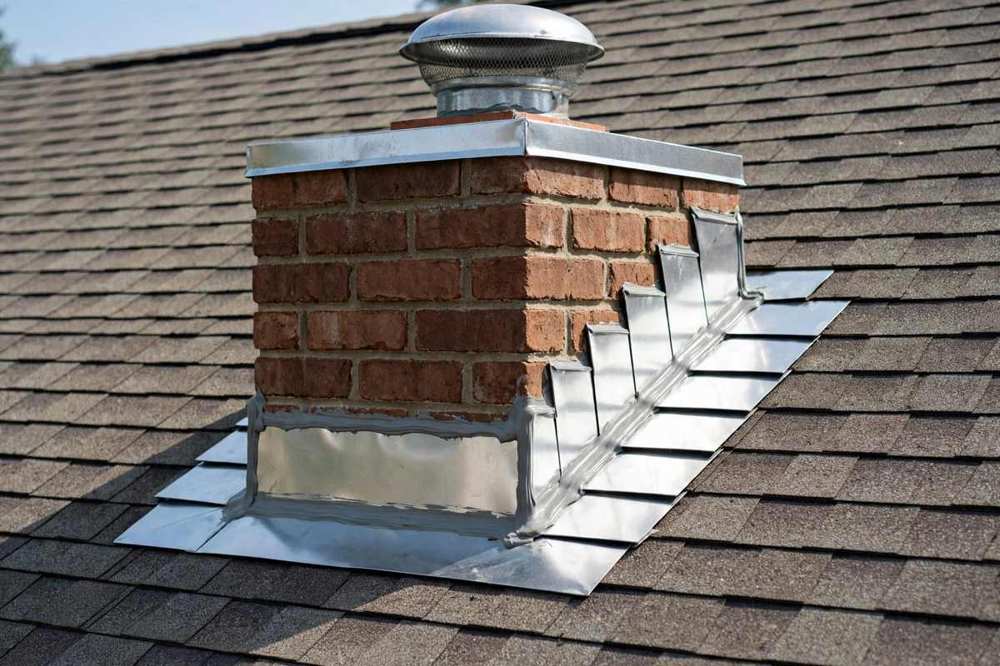
How chimney flashing is built
Chimney flashing has two parts, and both matter. Step flashing is a series of small L-shaped metal pieces, one per shingle course, woven into the shingles up each side of the chimney. Counter-flashing, also called cap flashing, is set into the chimney masonry above the step flashing and folded down over it, so water running down the chimney face drops onto the step flashing and then onto the shingles, never behind them.
At the top, uphill side of the chimney, a cricket or saddle, a small peaked diverter, keeps water from pooling against the masonry on wider chimneys. At the bottom, apron flashing carries water off the downhill face onto the shingles below. Every one of these pieces overlaps the one below it, like shingles themselves, so gravity always moves water outward and down.
Sealant is the last line of defence in this system, not the first. A joint that relies on sealant alone, with no proper metal overlap, will leak again as soon as the sealant dries and cracks, which Gardena heat and UV guarantee within a few years.
Why chimney flashing fails in Gardena
- Sealant ageing. Years of sun and thermal movement dry and crack the sealant where counter-flashing meets masonry. This is the most common chimney leak, and the simplest repair, when the metal underneath is still sound.
- Lifted or missing step flashing. Wind, or a previous repair that disturbed the shingles, can lift step pieces out of sequence. Once one piece is out of order, water runs behind the whole run.
- Rust or corrosion. Older galvanised flashing rusts through, especially where debris holds moisture against it. Rusted flashing cannot be resealed; it has to be replaced.
- Masonry movement. Small cracks in mortar joints or chimney crowns let water in behind the counter-flashing. A flashing repair that ignores a cracked crown will leak again from above.
- No cricket on a wide chimney. On a wide chimney, water and debris pool on the uphill face without a cricket, and the joint stays wet far longer than it should.
What a proper repair involves
- Inspect the whole joint, not just the wet spot. All four sides, the crown, and the mortar joints are checked, because a leak showing on one side can enter on another.
- Remove shingles around the flashing. Step flashing cannot be properly replaced without lifting the surrounding shingle courses, then re-laying them in sequence.
- Replace failed metal, reseal sound metal. Rusted or bent step and counter-flashing are replaced; sound metal is cleaned and resealed at the masonry joint with a sealant suited to roofing and masonry movement.
- Refit the cricket and apron where needed. A missing cricket on a wide chimney, or a damaged apron on the downhill face, is rebuilt as part of the same repair, not left for the next leak.
- Check the chimney above the flashing. A cracked crown or open mortar joint above the counter-flashing is a masonry repair, and it is flagged as one rather than hidden under new flashing.
Our flashing repair page covers this joint in the context of all roof flashings, and a chimney leak that turns out to be part of wider roof failure is handled through roof leak repair or, where the roof itself is at end of life, roof replacement. A roof inspection is the right first step when a chimney stain appears alongside other roof symptoms.
Safety and permits: what applies
Chimney work is roof work at height, on a slope, beside a masonry structure. It is not a ladder-and-tube-of-sealant job for a homeowner: falls from roofs are a leading cause of serious home-injury, and a chimney joint repaired from the wrong side, or with sealant smeared over failed metal, will leak again. If you are not equipped and experienced for roof work, this is a roofer's repair.
On permits, the distinction matters. A small flashing repair is not the same scope as a reroof. A full reroof in Gardena requires a building permit from the City of Gardena Building & Safety Division, with completed CF1R forms, and fees are valuation-based under the City's schedule effective 1 July 2026, with no flat residential reroof fee. If flashing work grows into a reroof, or you are unsure which side of the line a job falls on, check with the City counter at (310) 217-9530, which is the City's number, not this business's, before work starts. That check is what keeps a repair from becoming an unpermitted reroof. Homes in Gardena Downtown and Moneta, with older chimneys and older roofs, are where chimney flashing and masonry age together, so both halves of the joint are checked, not just the metal.
Get help with chimney flashing in Gardena
If a chimney is leaking, or if flashing has lifted or rusted through, call Nexo Xpert Roofing at +1 (562) 600-4041 to discuss an inspection and an estimate. A chimney joint is rebuilt, not just smeared with sealant.
Common questions
Why does my chimney leak if the chimney itself looks fine?
Because the leak is usually in the flashing joint, not the chimney. Dried sealant where counter-flashing meets masonry, or a lifted step flashing, lets water behind the metal and down the framing, even when the masonry looks sound.
Can I just reseal chimney flashing myself?
Resealing helps only when the metal underneath is sound and correctly overlapped. Rusted, bent, or out-of-sequence flashing has to be replaced, which means lifting surrounding shingles, and chimney work at height is a roofer's job for safety as well as technique.
Does a chimney flashing repair need a Gardena permit?
A small flashing repair is not the same scope as a reroof. A full reroof in Gardena requires a City of Gardena building permit with CF1R forms. If the work grows into a reroof, or you are unsure, check with the City of Gardena Building & Safety counter at (310) 217-9530 before work starts.
What is a chimney cricket, and do I need one?
A cricket is a small peaked diverter on the uphill side of a chimney that stops water and debris pooling against the masonry. It matters most on wider chimneys; on a narrow chimney, properly overlapped step and counter-flashing may be enough.
Sources and checks
Sources and checks: CSLB Check a License (California Contractors State License Board, C-39 roofing classification); City of Gardena Building and Safety Division, 1700 W 162nd St (re-roof permits, CF1R forms, valuation-based fees under the 1 July 2026 schedule); CAL FIRE/OSFM Fire Hazard Severity Zone Viewer (parcel fire-zone check). No licence number, firm price, or warranty term is claimed on this site.