Why is my roof leaking after heavy rain in Gardena?
Gardena rain falls mostly in winter bursts, and a roof that sheds a drizzle can still leak badly in a real storm. Here are the weak points that let wind-driven rain in, and what to do before the next one.
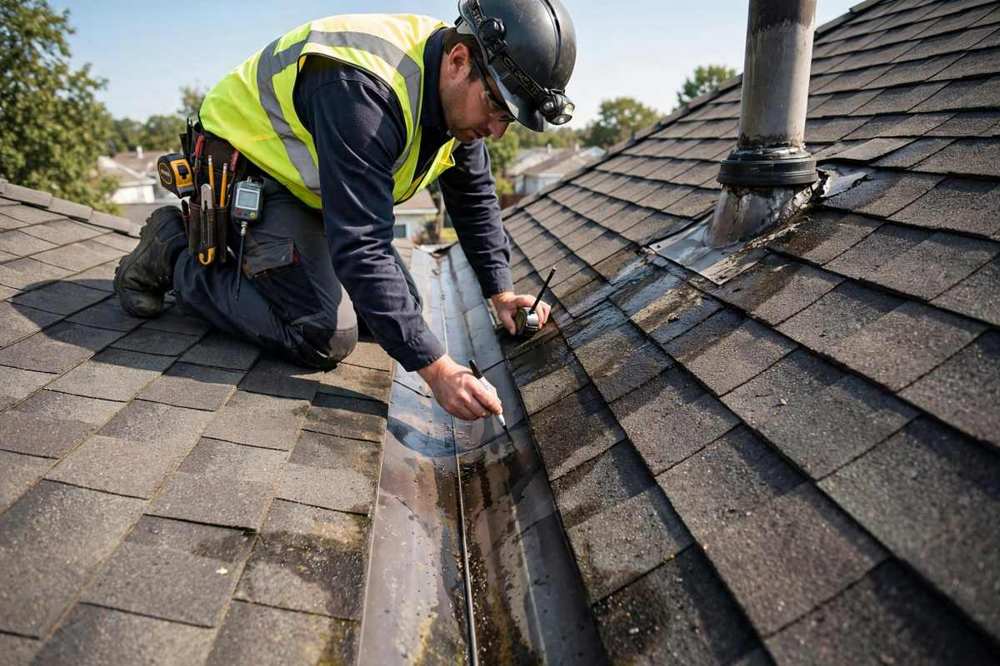
Why heavy rain finds the weak spot in a Gardena roof
Gardena gets about 13 to 14 inches of rain a year, concentrated from November through March, with near-zero rain in summer. That pattern matters: a roof can sit dry for months while sun and heat age its seals, then face its first real test in a winter burst. Heavy rain does not usually create a leak out of nothing. It exposes a weakness that was already there.
Wind is the other half of the story. In a Gardena storm, rain is often driven sideways, so water climbs under shingle edges, behind flashing, and into gaps that stay dry in still, light rain. Add Santa Ana wind season in autumn and winter, and the honest Gardena framing is wind-driven winter rain on an ageing roof, not a single dramatic storm type.
Age is the third factor. Gardena's median year built is 1964, and the largest building decade is the 1950s. On a roof of that era, underlayment and flashing are often older than the shingles above them, and a repair that only replaces a shingle can miss the failed layer underneath.
The five most common causes
1. Failed or lifted flashing
Flashing is the metal that seals joints where a roof meets a wall, chimney, vent, or valley. When the sealant behind it dries and cracks after years of Gardena sun, wind-driven rain slips behind the metal and travels down framing until it finds a place to drip. Flashing failure is the most common storm-leak source we describe on this site, and catching it early usually keeps the repair small.
2. Worn pipe boots and vent seals
Every plumbing vent that passes through a roof is sealed with a rubber boot. Gardena heat and UV make that rubber brittle over time. Once it cracks, water runs down the pipe and into the attic, often showing up as a stain directly below a bathroom or kitchen vent.
3. Valley and seam seal failure
Valleys carry a large volume of water during a downpour, and their sealant is wet, then dry, then wet again all winter. A hairline crack in a valley can let a surprising amount of water in during one heavy burst.
4. Lifted or missing shingles
Wind during a storm can lift shingle tabs or tear them free. Even one missing shingle exposes underlayment, and underlayment alone is not a long-term waterproof layer. Shingles found in the yard after a storm are a direct clue to the leak.
5. Clogged gutters and backed-up drainage
When gutters fill with leaves and debris, water has nowhere to go but up and under the roof edge. A leak near an eave or an exterior wall is often a drainage problem first and a roofing defect second, which is why gutters and downspouts are always checked on a leak call. See our gutter cleaning and gutter installation pages for how that drainage system is kept working.
What to do while it is still raining
- Contain the water inside. Put buckets under the drip, move furniture and electronics away, and lay down towels or plastic sheeting. If water is near an outlet or light fixture, switch off power to that room at the breaker before touching anything wet.
- Do not climb onto a wet roof. Wet shingles and tile are slippery, and a fall is far worse than a stained ceiling. Wait for dry, calm conditions, or call a roofer.
- Document everything. Photograph the stain, any wet insulation, and visible roof damage. If an insurance claim follows, that record matters, and no outcome is promised here.
- Clear drainage only if it is safe from the ground. If the wind has died down and you can safely reach a ground-level downspout outlet, clearing a blockage there can reduce backup. Do not use a ladder in wind or rain to reach a gutter.
Once the rain stops, a temporary fix still needs a real repair. Water sitting in an attic or wall cavity can feed mould growth, so a leak that has shown itself once should be diagnosed before the next winter burst, not left until it stains again.
When to call a roofer
Call a roofer when the leak is active, when you cannot find the source, when water is coming through a light fixture, when a ceiling is sagging, or when the same spot has already been patched more than once. Those are the points where guessing costs more than an inspection.
A leak diagnosis should find the actual entry point, which is often uphill or sideways from the stain inside. That is the work described on our roof leak repair page, and it is distinct from a general roof repair visit. If damage is widespread, a roof inspection can document the full roof condition, and our storm damage roof repair page explains how storm-related damage is documented. Where a roof has been patched repeatedly and keeps leaking, roof replacement may be the more honest long-term conversation than another round of patches. Homes near the Gardena Boulevard corridor and in Gardena Downtown and Moneta often carry the older stock described above, so age-related underlayment and flashing failure is a normal first suspicion there, never a diagnosis on its own.
Get help with a leaking roof in Gardena
If your roof is leaking after heavy rain in Gardena, call Nexo Xpert Roofing at +1 (562) 600-4041 to discuss an inspection and an estimate. We find the entry point, not just the wet spot, and explain the repair before work starts.
Common questions
Why does my roof leak only after heavy rain in Gardena?
Because wind-driven rain reaches gaps that stay dry in light rain: failed flashing, a cracked pipe boot, a valley seal, a lifted shingle, or a gutter backing water up under the roof edge. Gardena's rain is concentrated in winter bursts, so a weakness can sit unnoticed through the dry summer and show up at the first real storm.
How do I stop a roof leak during heavy rain?
You can slow it, not stop it, while it is raining: contain water with buckets and towels, switch off power to any wet electrical area, and do not climb onto a wet roof. A permanent repair has to wait for dry conditions and a diagnosis of the true entry point.
Can a clogged gutter really cause a roof leak?
Yes. When a gutter is blocked, water backs up under the roof edge and can enter at the eave or fascia. That is why gutters and downspouts are checked on every leak call, even when the stain is well inside the house.
Should I repair or replace a roof that keeps leaking?
A single failed flashing or pipe boot is usually a repair. Repeated leaks in different places, widespread underlayment failure, or a roof at the end of its service life point toward replacement. An inspection that documents the whole roof, not just the wet spot, is how that call is made honestly.
Sources and checks
Sources and checks: CSLB Check a License (California Contractors State License Board, C-39 roofing classification); City of Gardena Building and Safety Division, 1700 W 162nd St (re-roof permits, CF1R forms, valuation-based fees under the 1 July 2026 schedule); CAL FIRE/OSFM Fire Hazard Severity Zone Viewer (parcel fire-zone check). No licence number, firm price, or warranty term is claimed on this site.